Why Do We Make Decisions We Later Regret?
"It's not about making the right choice.
It's about making a choice and making it right."
― J.R. Rim
Our life is the sum of our decisions.
Everything I am today, I chose at some point, though I couldn't say I always made the best decisions. I'm sure I'd have saved a lot of time and energy if I'd chosen differently three years ago, and today I'd be further along than I am.
It happens to me often, to put myself through a bit of soul-searching over certain things I did or didn't do.
After going through that process, I ask myself what was behind my decision, and what I took into account at the time.
What held me back, and what helped me?
Doing this starts to shed light and helps me understand exactly how I function.
For example, a little over 2 years ago I wanted to start a blog, but I was so afraid of being exposed that I wrote my first article in English and published it on a different platform. You can read the article here.
Thankfully, Răzvan, my boyfriend, stayed by my side until I published it — he's even the one who clicked "Post" on Facebook. After that, I closed my laptop and went to sleep, more or less paralyzed by fear over how people who'd read it might react.
The next day, same thing — I hoped it had all been a dream and that I hadn't actually done it, but surprise: there was no turning back. Răzvan greeted me with a smile and told me to open my laptop and check Facebook. I saw there were a lot of reactions, all of them positive. I cried tears of joy, of sheer disbelief, unable to process what had just happened.
For me, it was a pivotal moment that gave my life a completely different direction. A whole series of events followed the decision to publish that article: I trained as a coach, then as a master coach, I attended various retreats and courses, I started studying psychology, and the changes have kept going in the same direction ever since.
It all started with an article that I could just as easily have left as a note in some forgotten document. The decision I made that evening turned out to be the right one: to take action, to take a first step toward what I would later realize was my dream. But in that moment, I was tempted to stay in my comfort zone and leave things as they were.
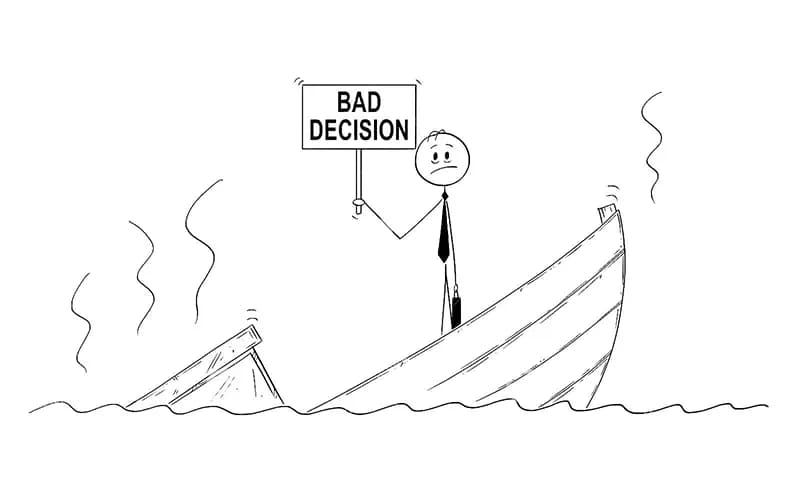
Another decision — a poor one, I'd say, this time — was when I chose to believe in others more than in myself. And here I have plenty of examples: personal and professional relationships I entered and often chose to stay in, even long after I should have left, simply out of comfort or out of fear that my life "wouldn't go on" without those people.
In other words, for years I chose to keep my head down and not take the risk of acting. And that led to losses in the long run. I'd say I lost opportunities, time, energy, money, and people, all because of my decision not to believe in myself.
Now, looking back, I realize that all those years were part of my preparation — specifically, part of the inner growth and development that helps me make the right decisions for myself today. Jokingly, I could say I learned "what not to do" from all the poor decisions I made 🙂
Next, I want to talk about how we make decisions, how our life changes with every decision we make, and especially how much we can trust our own judgment and reasoning.
Now I invite you to think about the last poor decision you made — a major one, not something like eating chocolate after 8pm. You might even want to grab a pen and paper to answer the following questions:
Think about how you made that decision. What did you take into account?
What stage of life were you in at the time?
How has your life changed since then? What have you lost between that moment and now? What have you gained?
You might discover that you chose a moment's pleasure and comfort, but with heavy losses in the long run.
Or maybe you wanted something so badly that you stopped caring about the consequences. You told yourself you'd deal with whatever came, without really knowing what that meant in practice. Maybe you're still paying today for poor decisions from the past, or maybe you're trying to make up ten years' worth of things you didn't do in just one.
Now that we've covered what can happen when we hesitate or make poor decisions, you might be wondering what to do and how to prevent certain bad decisions, or how you can make sure the decision you're considering is the best one for you.
One first step can simply be to act — to see what happens, and start building from there. To find the courage and keep moving forward. To gain confidence, to walk your own path, to learn, and to understand that you'll have many more small decisions to make along the way, not all of which will turn out to be right — but you'll learn from both what you did well and from your mistakes.
Another thing that helps me is the thought that, just as I made a decision, I also have the right to change my mind. In practice, you can choose to course-correct and change direction the moment you realize you didn't choose well.
Going further, you might feel the need to talk to someone who can help you clarify your thoughts and look at them with some distance and objectivity — that someone could be a coach.
In practice, a coaching process helps you objectively evaluate all the options available to you, discover what you actually want, identify the patterns and cognitive frameworks you use with every decision you make, and ultimately arrive at the decision that's right for who you are.
What actually happens in a coaching process?
To give you a few examples: maybe you have a goal you want to work on, maybe you want to figure out what you want from life, or maybe you know where you want to get to but not how.
Together, we then set a number of sessions around that goal or wish, and throughout the process I'll accompany you as a partner along the way, helping you discover and make the most of your potential and abilities, and, of course, get you where you set out to go.
The beauty of the coaching process is that it's a solution-focused process, led by the client, which means you'll decide what to do and how to act as you gain clarity and discover how you function.
You can find more details about the coaching process, and about how we can work together, here: https://ralucanedelcu.com/coaching/
In closing, I'll leave you with a question to take with you:
What decision do you have to make right now that could completely change your future over the next three years?
See you soon,
Raluca
Clinical psychologist, psychotherapist and ICF-accredited coach at PCC level. I work online with people who want clarity in their career and balance in their life.
Keep reading

Generation Z, often called the "generation of the sensitive ones" and fragile, has enormous potential. I've discovered they are courageous, ambitious, empathetic, kind, and flexible — potential well worth polishing and supporting to build tomorrow's world.

Those who "make money" for non-integrated reasons are less self-determined — they feel less autonomous, less competent, and have fewer fulfilling relationships. One explanation may be that Romanians place great weight on relative income, asking "how much do I have compared to others?" — a comparison that fuels dissatisfaction.
It's the reasons why you make money — not the money itself — that are linked to well-being and fulfillment in life.